I have always considered myself a reader. As a kid, I would prefer trips to the bookstore or the library over going to the park. I remember picking up Harry Potter and the Order of the Phoenix and not putting it down until I finished it that same day. It’s part of my identity, the same way ‘dog person’ and ‘night owl’ are.
Just don’t ask me how many books I’ve read in recent years. Please.
For the last few years, I’d start January strong and burn through a book or two. Then somewhere around May I’d look up and realize I hadn’t finished anything in weeks. But since it would still be early in the year, I ‘had time to catch up.’ Next thing I know, the calendar is showing November and I’d be cramming in reading sessions like it was finals week.
It wasn’t that I didn’t enjoy reading anymore; I just allowed other things to take priority.
This year I decided to actually do something about it. I kept the same goal I’ve had for the past 2 years: 12 books for 2026. Although I was changing up my strategy, I didn’t want to set myself up for failure with unrealistic goals. One book a month felt like a good benchmark.
But a funny thing happened: I’m already way ahead of that number, and it’s only June. Changing my approach to how I read worked.
This post is about those things. And it’s also the start of something new here on The Bold Dev, which I’ll get to at the end.
Embrace different formats
I’m not sure if this is a ‘hear me out’ situation or if everyone has been doing this since the dawn of time and I just missed the memo. I usually have a physical book, an e-book, and an audiobook going at the same time. It’s not to say that I am reading three different books simultaneously; it just means I always have something accessible no matter what I’m doing.
Right now I’m reading Gods of Jade and Shadow as both an e-book and an audiobook. As much as I’ve tried, I can’t get over the motion sickness when I try to read or use my phone inside a moving vehicle. So by having the audiobook accessible, I can pick up exactly where I left off whether I’m on my couch or commuting. Then I have I, Medusa as a separate e-book for when I want something different. I don’t have the audiobook for that one as there is a wait time on Libby that I refuse to wait for.
The logic is simple: a lot of my reading used to stall because the format wasn’t convenient for the moment. I didn’t want to lug a heavy book around everywhere. I’m on the train and my book is at home. I’m too tired to stare at a screen but I could listen to something. So meet yourself in the middle. Having options removes the excuse.
Use the resources you already have
Before you spend money on anything, please, I am begging you: check what you already have access to. The library is free. THE LIBRARY IS FREE.
Libby and Hoopla are both apps that connect to your library card and give you access to e-books and audiobooks at no cost. Libby has a waitlist system for popular titles, which is either a minor inconvenience or a lesson in patience, depending on your mood. Hoopla has no waitlist at all, but you have to read or listen to the book directly in the app. You can’t send it to an e-book reader, like Kindle. So there are definitely some pros and cons you have to weigh to find your favorite, but between the two, you can cover a lot of ground without spending a dime.
Use the library’s website and place physical books on hold! They’ll even ship it to your preferred library location (if that’s applicable). If you want physical books without the waitlist, garage sales are genuinely underrated. I’ve found great reads for a quarter. It’s chaotic in the best way.
If you track your reading, make it enjoyable
I know that not everyone tracks their reading. Even among those who do, there are so many differences in what and how to track. I’ve tried a few different systems myself.
Goodreads was probably one of the original digital ways to track and share online, but I ended up deleting that account because it wasn’t for me (among other reasons).
I ventured into creating a Notion setup that I built out to my liking. But I made it so detailed that filling it out daily with my progress quickly became a chore.
I downloaded and tried so many apps like Fable, Bookmory, Pagebound, Storygraph, among others. If there is a book tracking app out there, chances are I’ve tried it.
My history of good intentions is littered with tracking systems and apps that I set up with great enthusiasm and stopped using within a month. Luckily, I kept my Notion setup. I still use it as a digital catalogue of my personal library. But I can’t really repurpose all the abandoned accounts I probably have and forgot to delete.
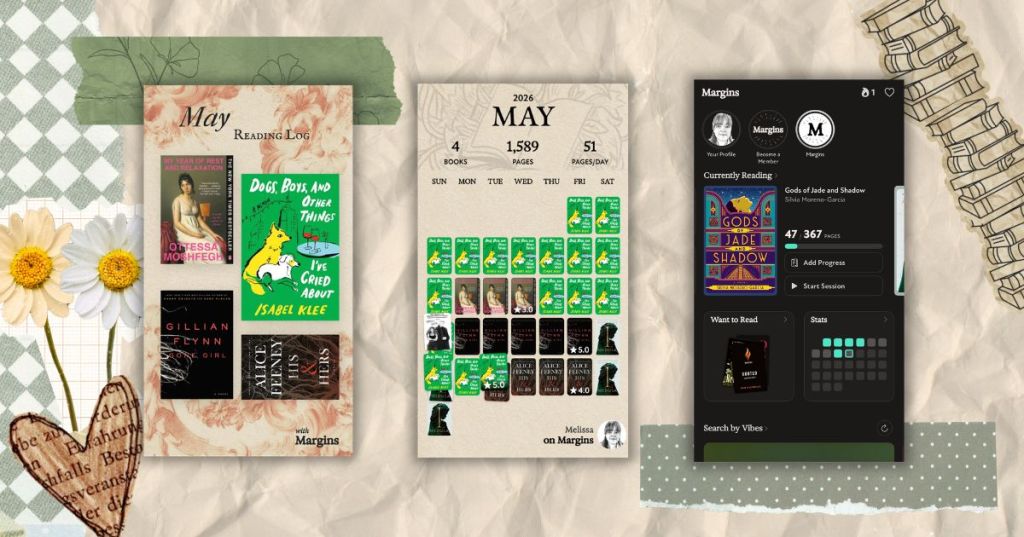
All that trial and error led me to find an app I genuinely like using. For me, that’s Margins. It tracks your pages, keeps a streak going, and my favorite part: it gives you a little end of month recap that is more satisfying than it has any right to be. The monthly layout that fills in the days with the covers of the books you read does something to my brain in the best way. It’s the same reason the mile a day challenge worked: small, visible progress is motivating in a way that a spreadsheet never was for me.
Margins is my app, but that doesn’t mean it’s the perfect fit for you. Just like Fable or Pagebound (or Storygraph or Goodreads) were not a fit for me. And that’s okay. The specific tool doesn’t matter as much as finding one you don’t dread using. Could be Margins, could be a notes app, could be a reading journal you picked up at a garage sale while you were hunting for books. Just find something that makes you want to log the win when you finish a chapter.
That being said, I will absolutely keep talking about Margins because I genuinely love it so much. Go try it. It’s free!
Read what you actually want to read
This one sounds obvious until you realize how much of your reading list is stuff you feel you should be reading. That book everyone on BookTok is talking about. Maybe it’s the classic you’ve been meaning to get to for ten years.
Don’t get me wrong. Browse the lists. Peruse the recommendations. Pick up a book you might have normally not picked up. But don’t feel obligated to read the book if it doesn’t pique your interest. At the end of the day, the best book is one you actually want to pick up.
I would even take it one step further. If you start a book, don’t be afraid to DNF it. DNF means Did Not Finish. For a long time, I treated it as a personal failure. But life is genuinely too short to keep reading something you’re dreading. If the writing isn’t clicking, the characters aren’t doing it for you, the plot is going nowhere you care about, that’s useful information. Put it down. The real battle is between your curiosity about how it ends and your complete disinterest in getting there. If disinterest is winning, the book is done.
Food for thought: Maybe the book isn’t for you right now. There is nothing in the world preventing you from picking it up at a different point in time and giving it another shot.
Find your people
In April, I ended up challenging myself to run every day. I don’t think I could have done it without the group of people who joined me for the ride. I believe the same principle applies to books. Having people who are reading alongside you and talking about the same book changes things.
While I’m technically in one right now, I haven’t been super active with the community side of it. So this is one of those tips I’m still figuring out for myself. I might need to find a better fit. If you’re in the same boat, I don’t think that means the concept is broken. It just means we haven’t found our people yet.
One more thing
All of this is a long way of saying that reading more in 2026 didn’t happen because I got more disciplined or more motivated. It happened because I stopped making it harder than it needed to be. Different formats, free resources, a tracker I actually like, and giving myself permission to quit a book without guilt. Small adjustments, real results.
And because I’ve been reading so much, I’m starting something new here on The Bold Dev: the Book Report series. Individual posts on books worth talking about, monthly roundups for everything else, and a half-year retrospective coming at the end of June. If you’ve been reading alongside me or want to, I’d love to hear what’s on your list.




 the bold dev
Leave a comment